
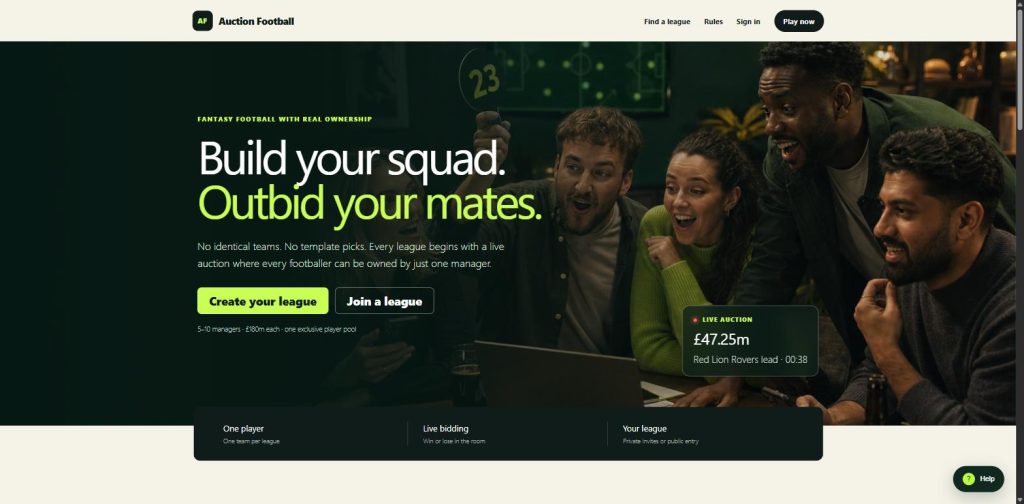
I’ve played Fantasy Premier League every season for years, but it always bothered me that ten different people could pick the exact same star striker. There was no scarcity, no real ownership, and no drama. So I set out to build something different: a browser-based fantasy football game where every player can only belong to one manager in your league, decided in a live auction. That idea became Auction Football, and the twist in the story is that I built the entire thing without being a professional coder, using Anthropic’s AI as my development partner.
The idea: fantasy football with real ownership
The concept behind Auction Football is simple to explain but surprisingly deep to play. Instead of everyone drafting from an unlimited pool of Premier League players like the official Premier League fantasy game, each league of five to ten managers runs its own live auction night. Every manager gets a budget of £180 million, and every footballer goes under the hammer in a 90-second timed lot with real-time bidding. Once a player is sold, they’re gone. Nobody else in your league can own them. That single rule changes everything about strategy, because you’re not just picking a squad, you’re negotiating, bluffing, and reacting to a live market alongside your mates.
Once the auction is over, the game becomes a season-long management challenge much like traditional fantasy football: picking a formation, setting your starting eleven, naming substitutes, and choosing a double-points captain every gameweek.

Building it with Anthropic instead of a dev team
I don’t have a computer science background, so a few years ago a project like this would have meant hiring developers or shelving the idea entirely. Instead, I worked through the entire build conversationally with Anthropic’s AI. I described what I wanted in plain English: a live auction engine with countdown timers, a player database tied to real Premier League squads, budget tracking, league creation and invite codes, a drag-and-drop squad and formation view, and a public/private league system, and the AI helped turn each of those ideas into working, structured code.
What made this possible wasn’t just generating code snippets. It was being able to go back and forth the way you would with a technical co-founder: explaining a bug, asking for a cleaner way to handle bidding logic, or requesting a redesign of the how it works section until it read clearly. Over many sessions, that back-and-forth produced a genuinely in-depth, production-ready web app, not a toy demo, covering everything from the live bidding room to post-auction squad management.

Why a browser-based, no-download game
Auction Football runs entirely in the browser, so there’s nothing to install and no app store friction. Managers can create a league, share an invite code with their group, and be bidding on their first player within minutes. That decision was deliberate: fantasy football thrives on group banter, and the easiest way to get five to ten friends into a live auction is to make it a single link away.
What I learned
The biggest lesson from building Auction Football wasn’t really about football, it was about how far AI-assisted development has come. Anthropic’s AI didn’t just write isolated pieces of code; it helped me reason through product decisions, like how long each auction lot should run, or how to stop a single manager from hoarding every top striker, and helped translate those decisions into a real, working site. For anyone sitting on an idea but held back by not knowing how to code, this project is proof that the gap between concept and launch is much smaller than it used to be.
If you fancy running your own auction night, you can create a league at Auction Football and challenge your mates to outbid each other for this season’s Premier League talent.


